
Congratulations to Phil Fox for setting a new record for the Circumnavigation of Lake Superior in these categories: Male, 18-49, upright Bike.
This is also an new Guinness World Record (non-age group)
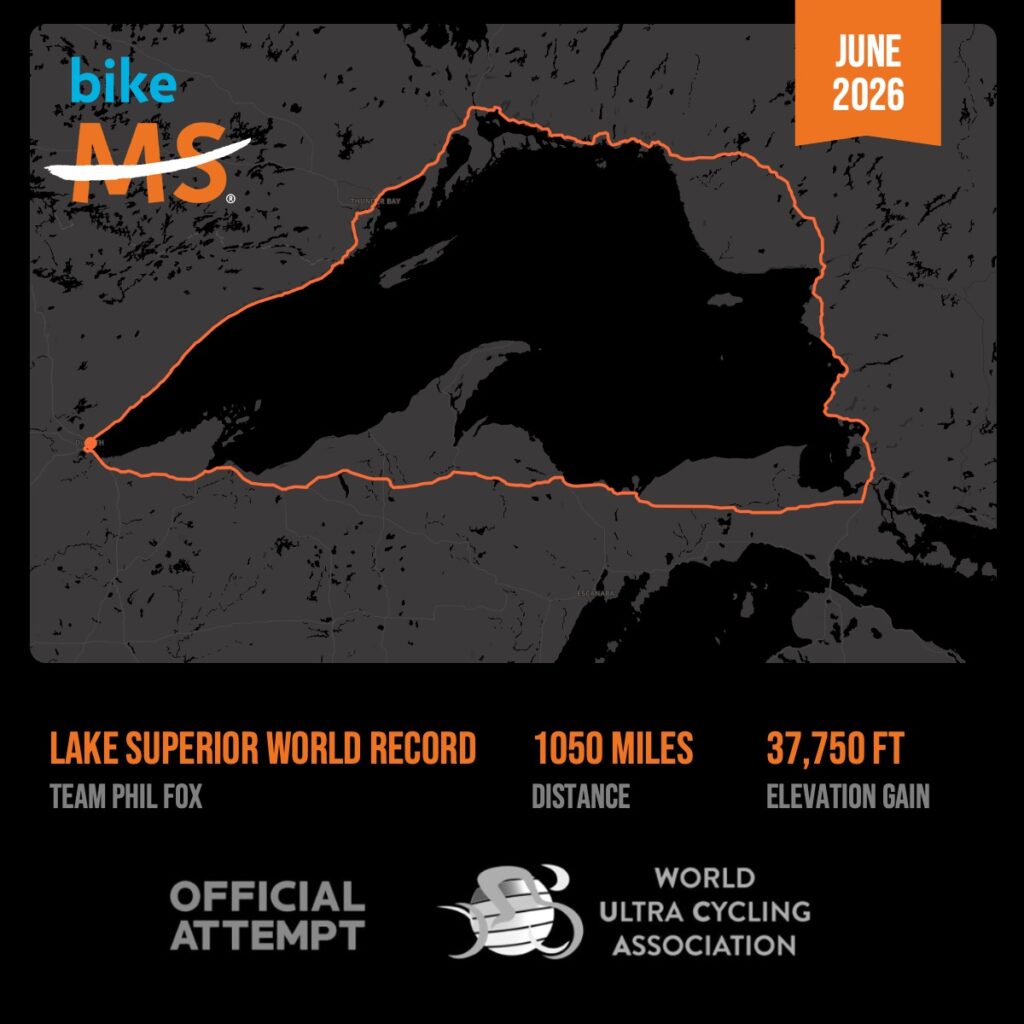
| Way Points # | Map Designation | Name | Country |
| 1 | Mile 0 | Marquette, MI | USA |
| 2 | Mile 408 | Pigeon River International Bridge | USA-CAN |
| 3 | Mile 884 | Sault Ste. Marie International Bridge | CAN-USA |
| 4 | Mile 1048 | Marquette, MI | USA |
Lake Superior:
Post Attempt Report Narrative
On June 18, 2026, Phil Fox and a team of eight crew members set out from the Iron Ore Dock in Marquette, Michigan in an attempt to set the world record for circumnavigating Lake Superior by bicycle in support of Bike MS and the National MS Society.
At approximately 1,050 miles and 36,000 feet of climbing, this would be our longest, most remote, and most ambitious world record attempt yet. It was also the final chapter in a six-year project to establish world records around all five Great Lakes.
From Marquette, we would travel clockwise around the largest freshwater lake in the world by surface area. Unlike previous Great Lakes attempts, there would be no shuttles, no shortcuts, and no major metropolitan areas to break up the journey. Just me and the road ahead.
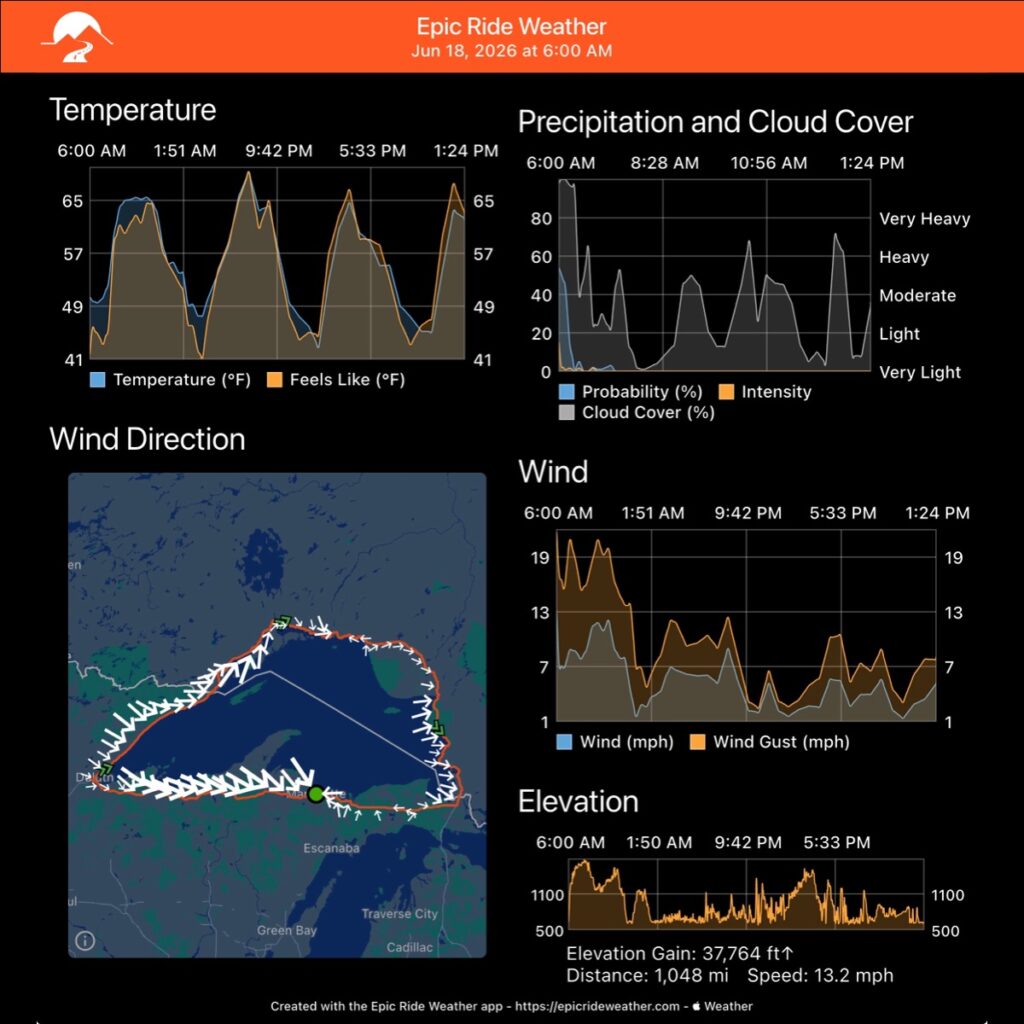
The route would take us west across Michigan’s Upper Peninsula to Duluth, Minnesota, before turning north along the rugged shoreline of Lake Superior crossing into Ontario, Canada at Pigeon River. From there, we would follow the Trans-Canada Highway through some of the most remote terrain in the Great Lakes region before crossing back into the USA at Sault Ste. Marie and returning to Marquette.
This would be our most remote Great Lakes route yet. There is no Chicago, Toronto, Detroit, Cleveland, Buffalo, or Milwaukee on the shores of Lake Superior. Instead, there are hundreds of miles of forests, cliffs, exposed shoreline, and stretches of highway where services can be separated by more than 100 miles.
Key waypoints would include:
- Marquette, MI
- Duluth, MN
- Grand Portage, MN
- Thunder Bay, ON
- Marathon, ON
- Wawa, ON
- Sault Ste. Marie, ON
- Marquette, MI
While many cyclists have successfully circumnavigated Lake Superior, little evidence exists of any documented attempt to determine just how quickly the route can be completed by bicycle.
Accompanied by a rotating crew of eight people and multiple support vehicles, we planned to employ a Race Across America-style support strategy designed to minimize stoppage time while maximizing rider safety and efficiency. Rather than relying on an RV, the crew would rotate through hotels and motels along the route, allowing us to maintain nearly continuous forward progress around the world’s largest freshwater lake.
The previous four Great Lakes had taught us many lessons. Lake Superior represented our chance to apply everything we’ve learned and test our mettle, one last time.
Marquette, MI / Starting Line
I woke up a few minutes before my 5:00 AM alarm. Nothing was open, so breakfast consisted of my first of many Ensure shakes and a Mountain Dew donut from Kwik Trip. Breakfast of champions.
Overnight, we had already encountered our first challenge. Thunderstorms moving through Chicago had disrupted flights across the Midwest. Tony Moguel had an extended layover in Chicago en route to Green Bay. Emily Reel and Michelle Hartman were delayed in Detroit on their way to Marquette. All three would arrive well after I had gone to sleep the night before.
Somehow, the rental car agency at the Marquette airport stayed open long enough for us to pick up our third support vehicle. Tony, meanwhile, improvised. After his flight plans unraveled, he took two separate buses from Green Bay to Escanaba and then on to Marquette. His final bus pulled into town at 5:15 AM just in time to catch the start line.
With the film crew already wandering around the Airbnb, I scrambled to get dressed and ready. Moderate rain had fallen overnight and was still coming down, although the forecast suggested it would clear within a couple of hours. For once, I opted for a rain jacket and rain pants that I had never worn before. While I packed rain booties, I decided toe covers would be sufficient.
They would not.
With no fanfare, we rolled away from the foot of the Iron Ore Dock at exactly 6:00 AM Eastern time.
We immediately began climbing out of Marquette, heading west into a growing headwind. At the same time, we adjusted our crew rotations, with our newest crew member, Kajal Joshi, joining the day crew as our medic and nutritionist.
By the first crew exchange, we were already behind pace. Although the roads dried out by the third hour, our route along the south shore offered little shelter and no way to hide from the wind. The day crew also noticed something else: my position on the bike looked off. Spoiler alert: saddle rails can slowly migrate backward over time.
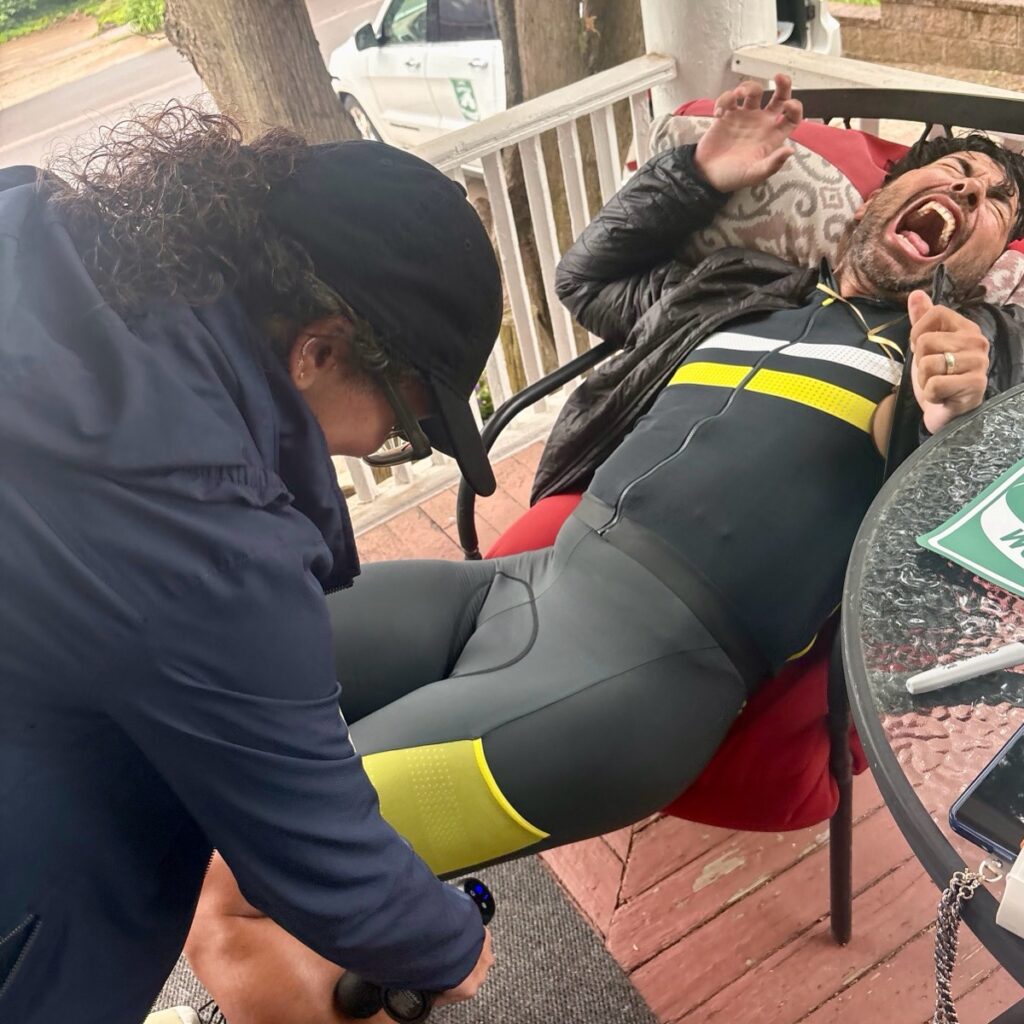
Of all the things we remembered to pack for a 1,050-mile world record attempt, we forgot the massage gun. The comfort crew’s first assignment once awake was to find one before we disappeared into the wilderness. Their second assignment was to locate a set of replacement brake pads after discovering that the climbing bike had almost no stopping power in the front brake.
We weren’t even out of Michigan yet.
Wisconsin-Duluth
The first crew exchange was badly needed. Kajal broke out the newly acquired massage gun and worked on my back and traps, already tightening up far earlier than anyone would have liked.
Up ahead, Duluth represented the first critical juncture of the route. It was the largest population center we’d encounter, featuring some of the most complex navigation on the entire course, and most importantly, marked a roughly 135-degree turn. For the first time since leaving Marquette, we would stop fighting a headwind and begin heading northeast with Lake Superior directly at our side.
All evening, we counted down both the minutes to sunset and the miles to the Richard Bong Memorial Bridge, named after the World War II fighter pilot who shot down an astonishing forty enemy aircraft. The bridge would carry us from Wisconsin into Minnesota, marking the first time we’d crossed into the state during any of our Great Lakes world record attempts.
Not long after entering Duluth, we encountered our first major road closure. Knowing only that I needed to find a pedestrian crossing over Interstate 35, I began improvising my way through construction zones. Unfortunately, the pedestrian bridge we had scouted months earlier had been completely dismantled.
After some wandering, I found the Lakewalk and followed it past the westernmost point of Lake Superior, with the iconic Aerial Lift Bridge illuminated in the background. It was one of the more surreal moments of the ride: after hundreds of miles battling rain and headwinds, suddenly finding myself rolling along a lakeside path in the heart of Duluth at sunset.
Reunited with the follow vehicle, we began climbing up Scenic Highway 61 along Minnesota’s North Shore. The lake remained mostly hidden in the darkness, but its presence was impossible to ignore. One by one, the sleepy lakeshore towns slipped by. Two Harbors. Silver Bay. Grand Marais. And was that a Gray Wolf crossing the road? The debate continues. By sunrise, the landscape had transformed.
Minnesota’s North Shore
The Sawtooth Mountains emerged from the morning haze as the sun rose over Lake Superior. This is an ancient landscape. More than one billion years ago, massive volcanic eruptions associated with the Midcontinent Rift poured lava across what is now the Lake Superior basin. Later, glaciers carved valleys and exposed the resistant volcanic rock that gives the North Shore its rugged character today.
As the terrain steepened, we moved up the crew exchange point so that the night crew could push ahead to the Grand Portage. With no possibility of a late checkout and hundreds of miles still ahead of us, they needed every minute of sleep they could get.
At Grand Portage, we made another significant decision: we switched to the climbing Roubaix.
This would mark the first time the climbing bike had been used during any of our Great Lakes world record attempts, and the first time it had seen race action since the 2022 Race Across America.
In preparation for Lake Superior, we had quietly broken some of our own rules. Shortly before leaving Chicago, we modified the climbing bike to more closely match the fit and aerodynamics of the primary machine. We installed a new handlebar setup, added aero bars, and switched to the E3 Infinity saddle.
After some investigation, our mechanic Demian discovered that the reach on the aero bike had gradually drifted away from our intended fit. Credit goes to Adam at Peregrine Bicycle Studio for dialing in the climbing bike before we left. To my relief, the climbing bike felt significantly better, and the crew immediately confirmed that my body position had improved. It would prove to be one of the most important equipment decisions of the entire attempt.
By the first 24 hours, we had covered a respectable 371 miles.
But the easy part was over.
Day two would include nearly forty significant climbs before our one and only planned sleep break in Marathon, Ontario. There was no alternative. Beyond Marathon lay the most remote section not only of this route, but of all five of our Great Lakes world record attempts.
My head cold was not improving. The congestion had moved into my chest, and an overnight coughing fit had culminated in an impressive rolling vomit session somewhere on Minnesota’s North Shore.
The second significant decision of the morning was to begin a DayQuil regimen to combat the rattle in my chest and the endless congestion that had been progressively worsening since the start. At 371 miles into a 1,050-mile effort, there was no longer any point in pretending it was going to get better on its own.
Pigeon River International Border
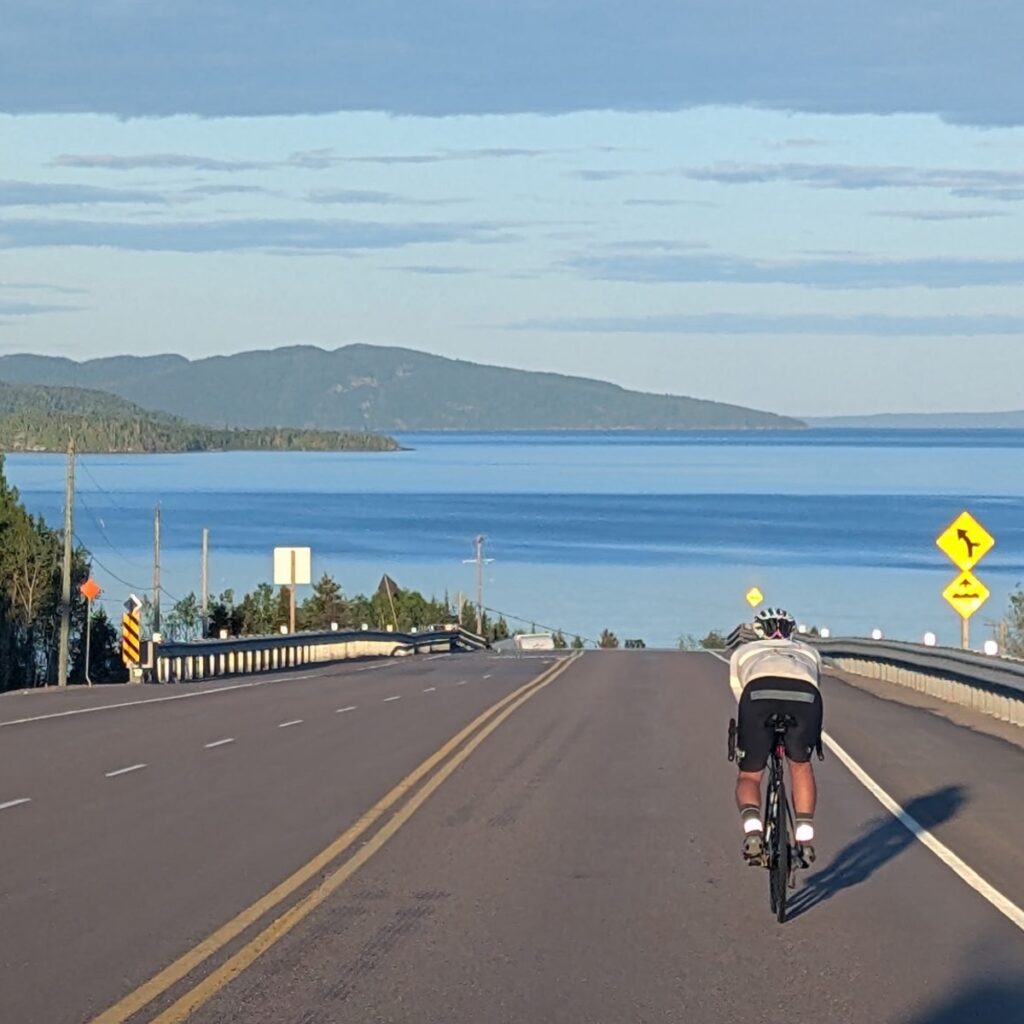
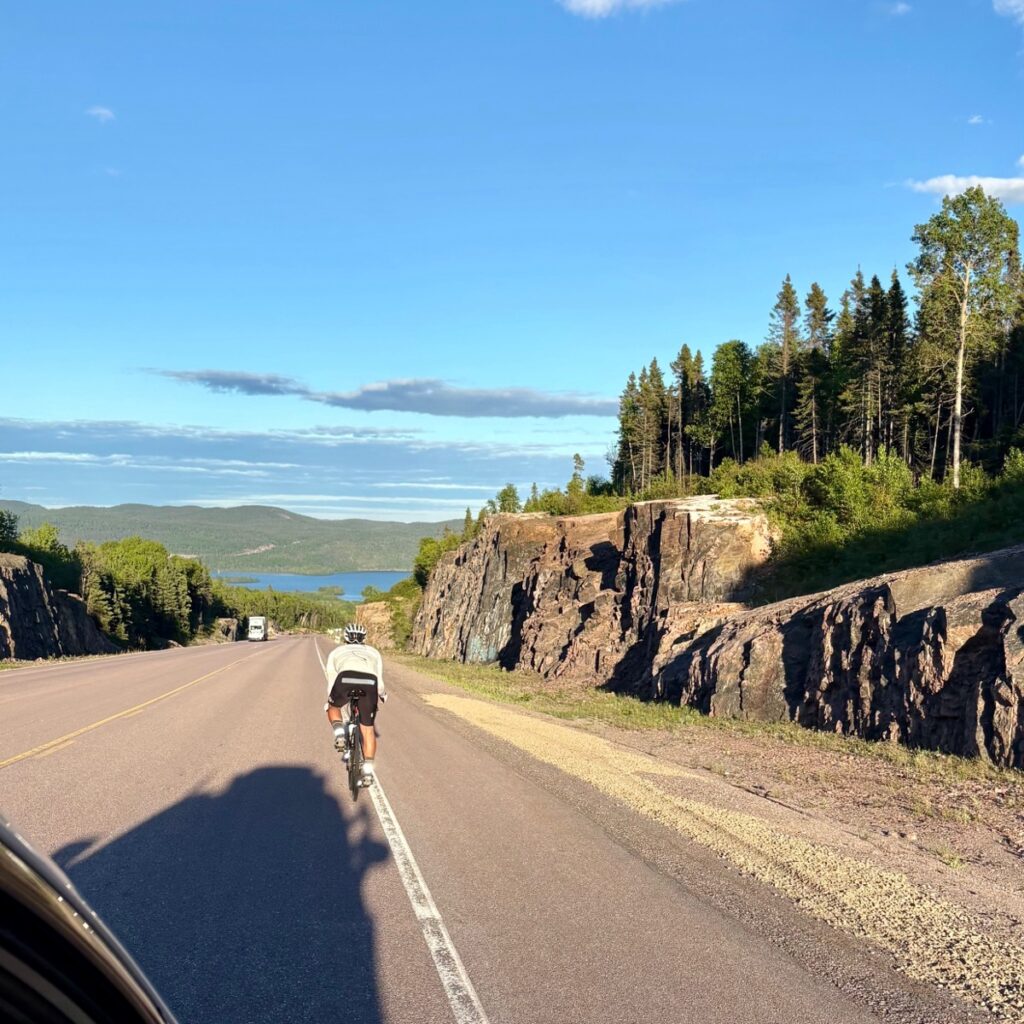
As the film crew documented the crew exchange, I rolled out ahead of the support vehicles in anticipation of the border crossing. While we’ve historically had good fortune crossing between the United States and Canada, it doesn’t take much for an international border to become a major complication. Briefly separated from the crew, I found myself climbing ridges and descending back toward Lake Superior with increasingly spectacular views.
Without question, this would become the most scenic terrain we had encountered across all five Great Lakes world record attempts.
The border crossing itself turned out to be wonderfully uneventful.
“And what’s going on here?” asked the border agent.
“Attempting a world record.”
“What are you bringing into Canada?”
“Two water bottles.”
“How long are you staying?”
“Thirty hours. Plus or minus.”
It never gets old.
While temperatures on day one never climbed beyond the mid-70s, day two was beginning to warm up. From this point forward, we would spend almost the entirety of our Canadian leg on the Trans-Canada Highway. The only real exception would be our passage through Thunder Bay, involving a maze of industrial access roads and busy urban thoroughfares.
At approximately 125,000 people, Thunder Bay represented the largest metropolitan area on the Canadian side of the route. For comparison, Toronto’s metropolitan area exceeds 6.7 million people. In fact, only about 600,000 to 700,000 people live around the entirety of Lake Superior.
The Road to Nowhere
Leaving Thunder Bay, we briefly found ourselves on what felt like a highway to nowhere.
The Trans-Canada widened into a divided four-lane highway with enormous shoulders and almost no traffic. For a brief moment, it felt like we had discovered a cheat code. Unfortunately, it didn’t last.
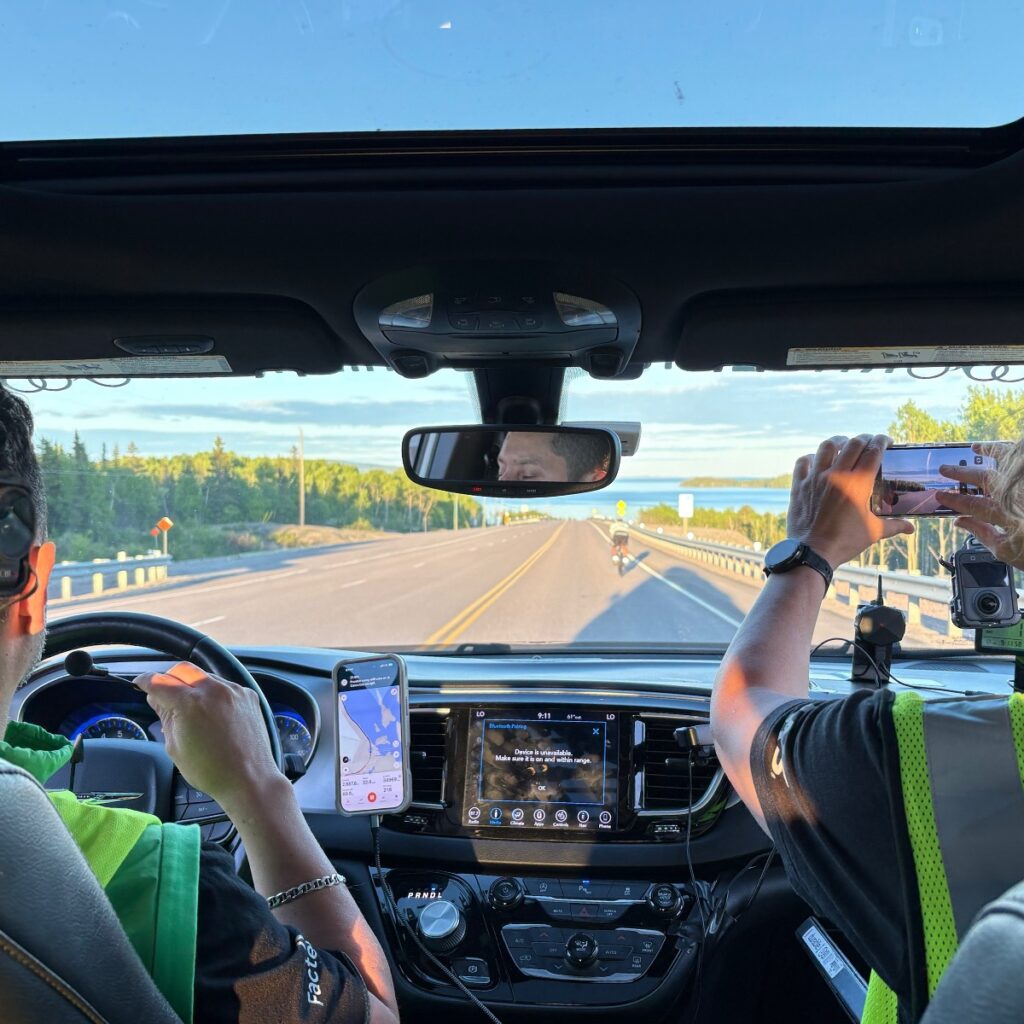
Before long, the road narrowed back to two lanes with intermittent or nonexistent shoulders. Credit goes to Demian, our day shift driver, for enduring hours of white-knuckle driving to keep me safe.
While I’m largely immune to the stress of traffic while riding under direct follow protocol, there was one moment that got everyone’s attention. An impatient driver attempted to pass us using the unpaved shoulder rather than crossing the double yellow line. Whether they couldn’t see around the curve or simply didn’t want to wait, we’ll never know. It served as another reminder that every passing maneuver on these roads involved some degree of trust and calculated risk.
The original plan called for the day crew to take me all the way to Marathon, Ontario, approximately 630 miles into the attempt. Our moving efficiency remained exceptional at around 95%, but the headwinds, relentless climbing, and the worsening head cold were all beginning to take their toll.
Even the services reflected the remoteness of the route. Gas stations were often little more than fuel pumps and a convenience store. Hot food was far from guaranteed. Sometimes even bathrooms were optional. More commonly, we found food trucks and port-o-johns One memorable stop featured a mobile poutinerie serving samosas and hamburgers.
As the afternoon wore on, the crew began floating the idea of moving our planned sleep stop forward to Terrace Bay at mile 583.
I was not interested.
Stopping early would leave nearly 470 miles remaining after our only planned sleep break. At no point was I willing to entertain the possibility of a second. Not necessarily overruling the crew chief, I rededicated myself to maintaining the original and only real strategy.
We opted for a short night shift to get me to Marathon. Rejoining the crew for the Canadian leg was Phil Parker, our crew chief from Race Across America. We also rotate in Tony to take the wheel while Morgan takes a rare shift off ahead of the final leg.
While the ultimate decision on where to sleep would remain a team decision, I knew exactly what I intended to do. All I could do was keep moving. Time to begin the caffeine protocol.
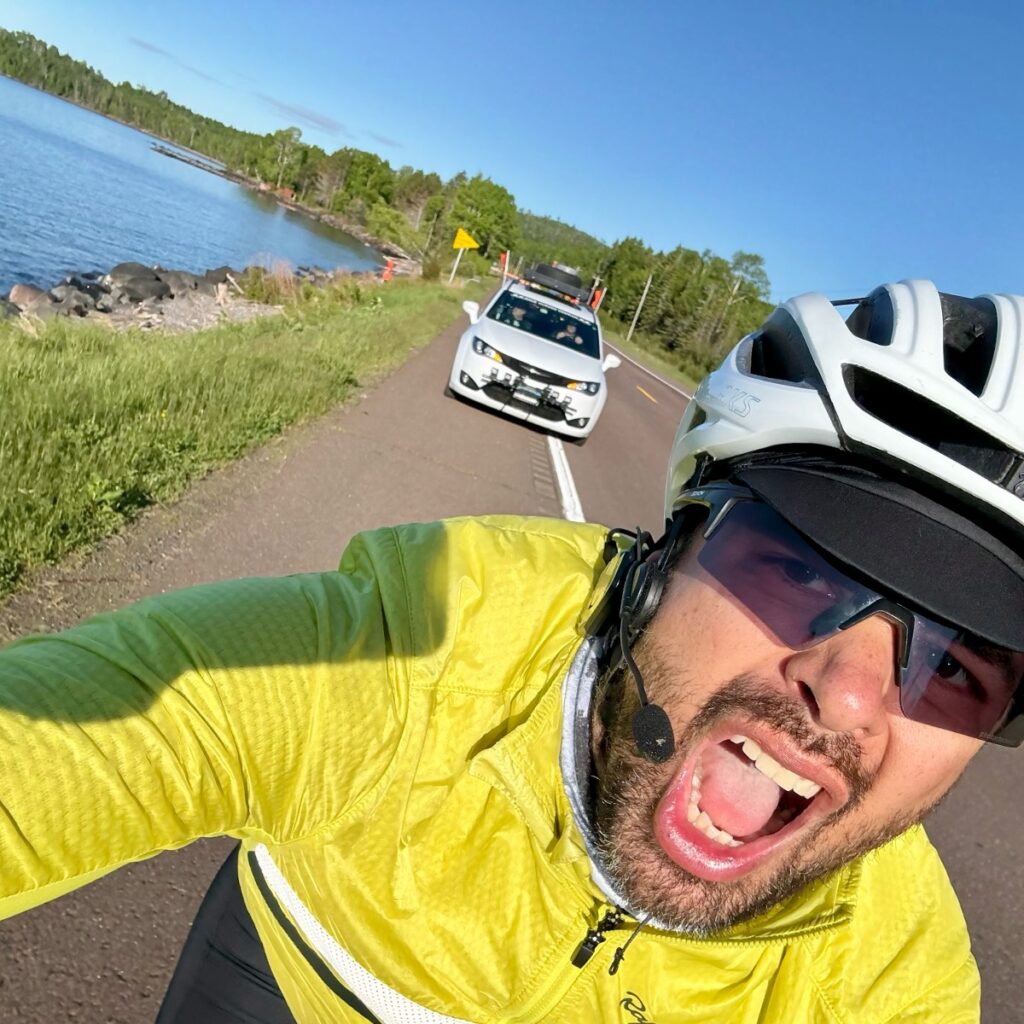
For the second night in a row, my microphone on the Vertix communications system also began to fail. I could still hear the crew perfectly, but a combination of condensation from my breath and dropping temperatures had rendered my mic largely useless. Desperate to keep me awake and engaged, the crew began inventing games and trivia challenges over the radio while I resorted to responding via an increasingly elaborate series of hand gestures and charades.
And am I seeing things? “Was that a bobcat!?” Confirmed. That was definitely a Bobcat crouched under the guardrail as I rode by.
Marathon, ON
At 3:18AM, we arrive in Marathon, Ontario. 631 miles in 45 hours, 18 minutes. We were unable to secure hotel rooms directly on course, meaning we would have to shuttle approximately 3.5 miles into town for our only planned sleep stop.
With no real alternative, I was ushered into the hotel room. One quick shower. Some brief body work. Then I set an alarm for exactly 180 minutes. Out like a switch.
I woke simultaneously to the alarm and the day crew walking into the room with a fresh kit. I hacked up a night’s worth of congestion as best I could before inhaling a breakfast sandwich and recording a quick Instagram reel before heading back to the highway.
No time to waste. The giant mosquitoes were already out and ready to swarm.
Black flies had been one of our major concerns heading into the event. In Northern Ontario, they can swarm, bite, and draw blood. Mid-June is typically peak season. Fortunately, the wind, cool temperatures, and constant highway riding had largely rendered them a non-factor.
Mosquitoes, on the other hand, were relentless.
Every stop became a battle. They swarmed the support crews during exchanges and tormented the media crew whenever they stepped out of the vehicles.
We still weren’t out of the woods when it came to climbing. The route continued to undulate as we drifted away from the immediate shoreline. With little else to occupy our minds, we passed the time discussing World Cup results and speculating about the upcoming NBA Draft.
Could Peterson fall to the Bulls? Would they trade up for Wagner? Spoiler alert: no.
Somewhere around mile 700, we rolled through White River, Ontario, home of the real Winnie-the-Pooh. The original Winnie was a black bear cub named after Winnipeg, adopted by a Canadian cavalry regiment on its way to fight in World War I before eventually finding a home at the London Zoo, where she inspired A. A. Milne’s famous stories.
I really do come across the wildest shit out on the road. One quick photo at the roadside attraction and we were back at it.
The next major landmark would come in Wawa. The crew had set up camp beneath the giant Wawa Goose, perched high above the highway and attracting a small crowd of curious spectators. After hundreds of miles of wilderness, it felt strangely comforting to have people cheering us on.
With few options available on course, Wawa represented a critical opportunity to refuel before another long night. Bring on the Tim Horton’s. And bring on the cross-tailwind that would push us toward the border.
The Last Night Shift
Morgan was back behind the wheel after a rare night off. One of the benefits of rotating experienced crew members after so many miles together is that everyone knows the drill. Nobody needs much explanation and everyone can settle into their role quickly.
Lake Superior Provincial Park was one of the sections I had been most concerned about before the ride. Looking at the route, all I saw was a two-lane road, little shoulder, and a lot of wilderness. Instead, it turned out to be one of the more pleasant stretches of the entire attempt. Traffic was surprisingly light and, aside from a few frustrated commercial truck drivers, the road felt almost empty. The scenery didn’t hurt either.
One memorable crew exchange took place at a recreational pull-off. I asked where the bathroom was. The response from the crew was immediate.
“You won’t like it.”
Naturally, I insisted.
After walking through a cloud of mosquitoes and black flies, we discovered that the bathroom consisted of a wooden box over a pit toilet deep in the woods. That was it.
“Okay,” I said. “I’ll hold it.”
After countless roadside signs warning about wildlife, we continued keeping our eyes peeled for moose and bears. The rotating crews reported seeing a few bears, in some cases just a few miles ahead of my location but I never did. I spent hours scanning the tree line hoping to spot something. I did, however, hear what sounded like deep guttural groans coming from the woods on two separate occasions. Not that I was interested in racing a moose after learning that I would absolutely lose. Paranoia hits a little harder when you’re sleep deprived.
As we approached Sault Ste. Marie and re-entered civilization, we immediately hit road construction. We said goodbye to Phil Parker and stopped for a quick roadside break. No clothing change. No elaborate stop. Just a McDouble and some fries before Emily rotated back into the vehicle.
At some point during the stop, Michelle pointed out that I had spilled ketchup on myself.
Spoiler alert. That wasn’t ketchup. Gross.
Reinvigorated, it was time to cross back into the United States over the International Bridge. To our surprise, nobody else was on it. I took the lane, scrambled to find enough Canadian dollars to pay the toll, and carried out the usual conversation.
“What are you doing?”
“Setting a world record.”
“What are you bringing back?”
“Just these water bottles.”
“Where are you from?”
“Chicago.”
“Welcome home.”
“Good to be home.”
And just like that, after more than 800 miles around Lake Superior, we were back on our home turf.
The Home Stretch
As we settled into the final stretch back toward Marquette, we started doing what every ultra cyclist eventually does: counting backwards. How many miles left? How much time left?
It was getting increasingly difficult to stay warm. First came the knee warmers. Then the winter socks. Then the toe covers. Before long, I had added a winter jacket, buff, and cap. Unfortunately, the caffeine protocol wasn’t hitting the same way anymore. I started seeing double and found myself struggling to maintain focus.
Twice I called for a fifteen-minute nap in the van to reset, but I couldn’t fall asleep. Meanwhile, the day crew noticed we weren’t moving and began adjusting the next crew exchange. Kajal made the call: double the caffeine and get him back on the road. We were too close to let the wheels come off now.
By this point, we’d somehow managed three consecutive crew exchanges without a bathroom. I immediately blow past the planned stop. “There’s a bathroom six miles ahead?” See you there.
The final approach to Marquette would involve a long stretch of M-28: two lanes, a narrow shoulder, and plenty of Father’s Day recreational traffic. Whether it was the warming temperatures, accumulated fatigue, or simply the realization that we might actually pull this thing off, this section felt like a death march.
And then I saw my kids.
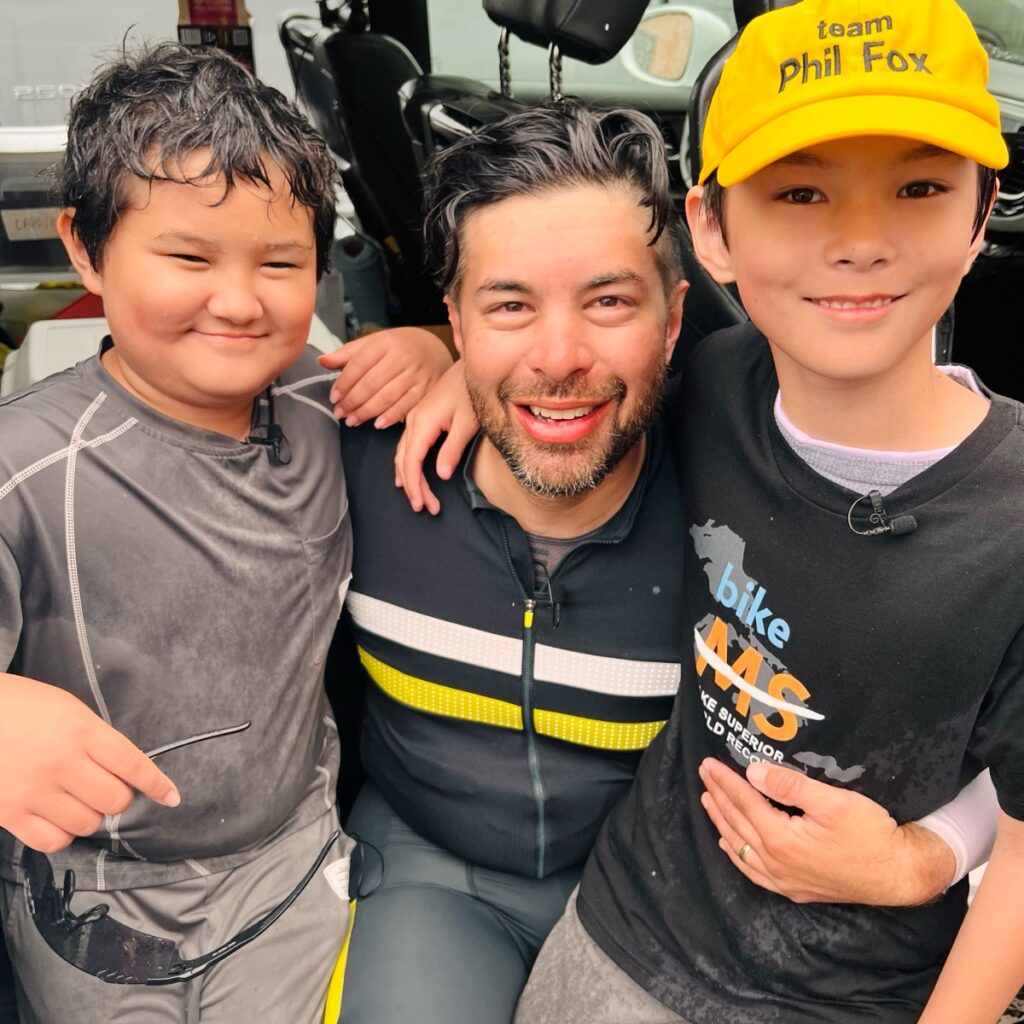
Passing through Munising, the crew had coordinated with my mother-in-law to bring Leanne and the boys out to the roadside. Just like Paris-Brest-Paris, I reached out and slapped hands with everyone as I rode by. It was electric.
Then the ugly cry started a la Matthew McConaughey in Interstellar. I had to choke it back. After six years of ultra racing and world record attempts, my kids were finally seeing it for themselves. Forty miles remained, and there was no way I was going to drag myself to the finish line like some tired dog. I promise Emily and Michelle that they’d be in the finish line photos before their afternoon flights home.
At this point, William and the crew started doing the math on what it would take to maintain a sub-80-hour finish. Initially, I refused to engage. I was already at my limit and all I could do was keep moving. But then I started doing the math myself. The speed picked up. I got aggressive. I started hunting for the smoothest line possible, aggressively moving between the shoulder and the fog line.
Let’s do some of that pilot shit. Turn and burn. Maverick supersonic.
After riding through the night bundled up in winter gear, I was suddenly overheating. I wanted to stop and strip off the knee warmers. “No time. Do it at the finish.” I wanted to stop and pee. “Hold it.”
Then I heard it.
Pss-pss-pss-pss.
“The bike’s flat.”
“No, it’s not.”
“The bike is absolutely flat.”
I took the opportunity for one final roadside leak and, by the time I finished, the aero bike was ready to go. Garmin moved over. Fresh bottles. And we’re back at it. NASCAR pit stop. Like this crew had been doing it for years. Now keep it upright. No mistakes. Let’s go.
Finish Line
Every finish line is special and this one was no exception with Leanne and our kids waiting for a special (albeit wet) Father’s Day finish. The final approach would route me onto the Iron Ore Heritage trail allowing the follow vehicle to leapfrog ahead to welcome me in at the finish.
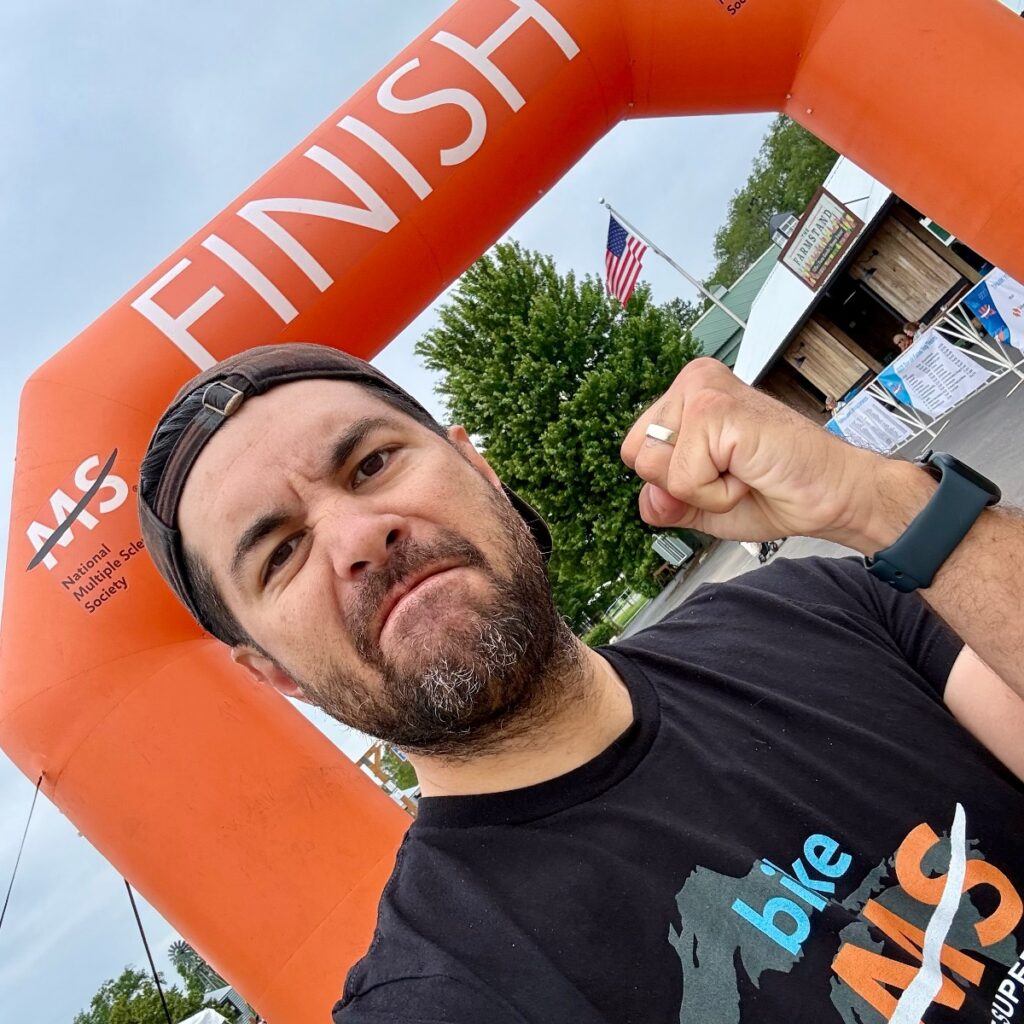
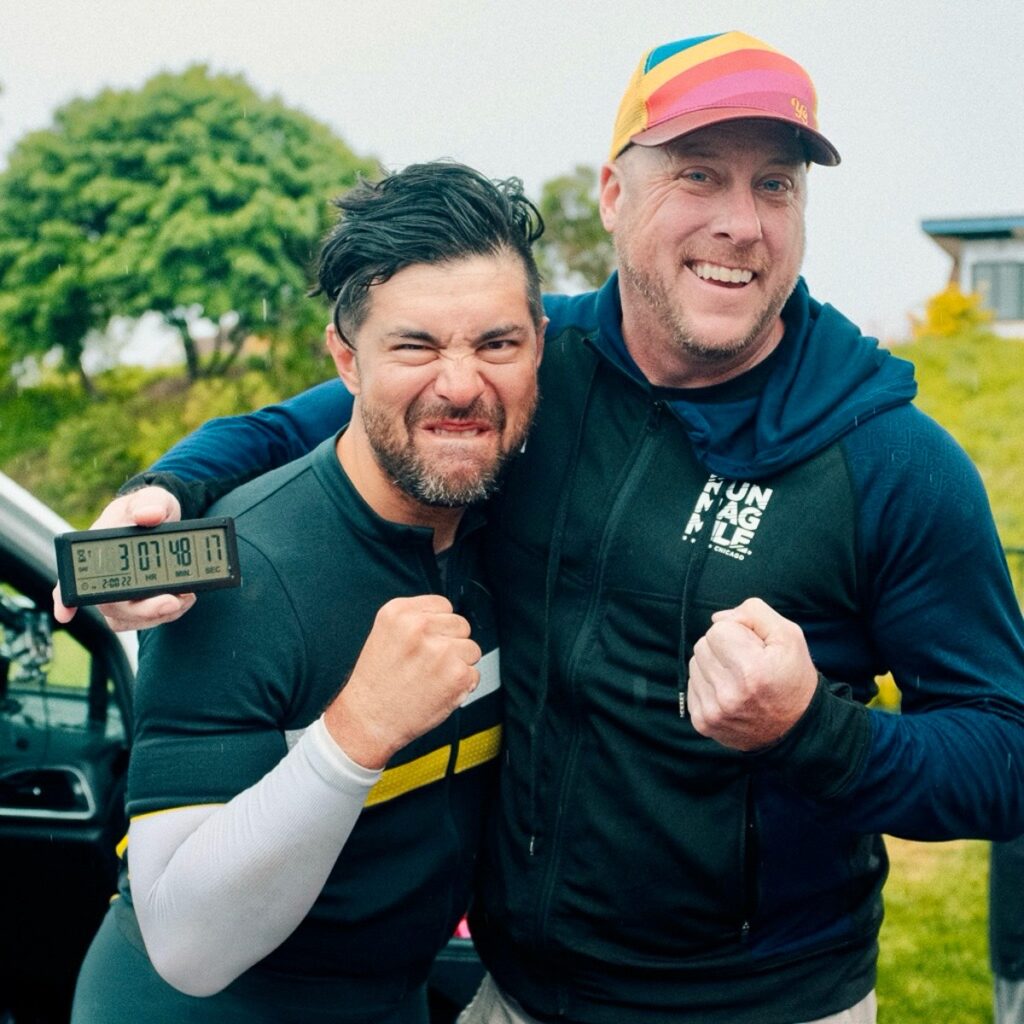
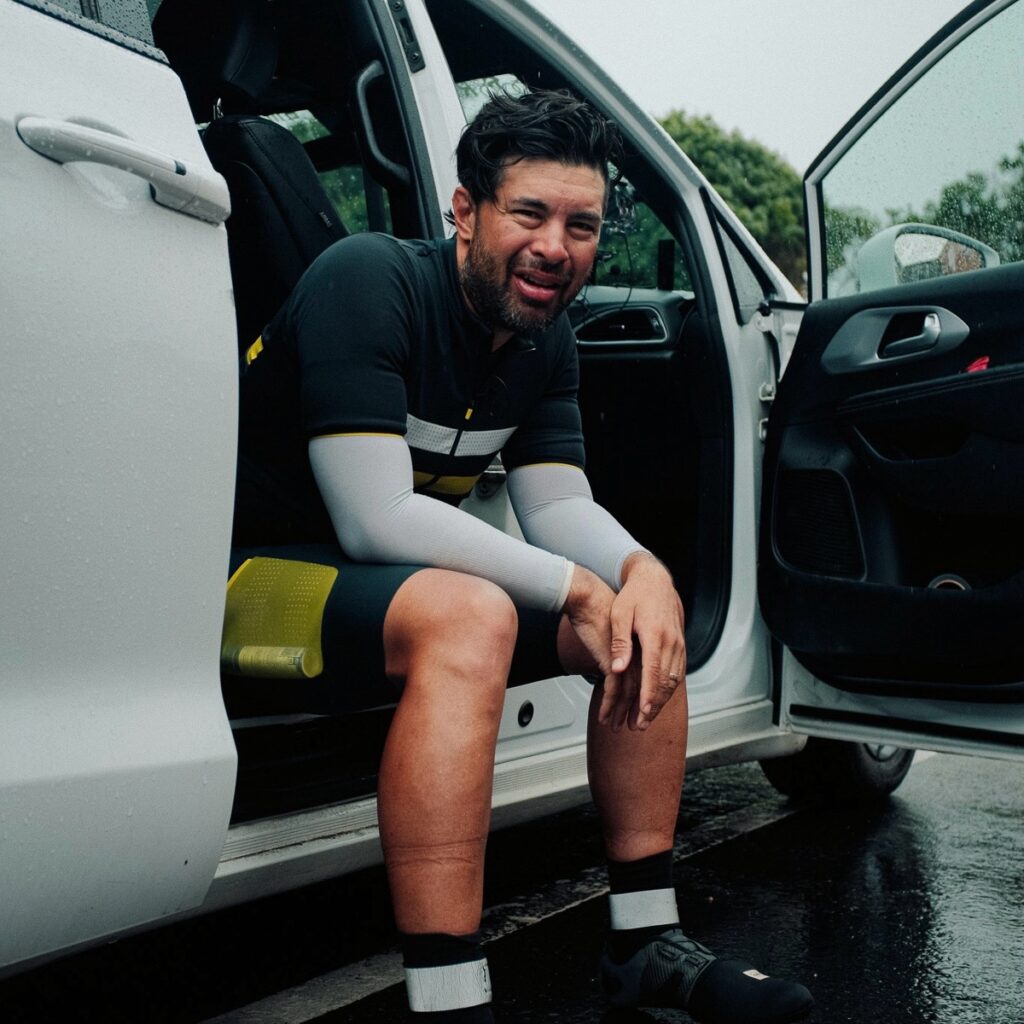
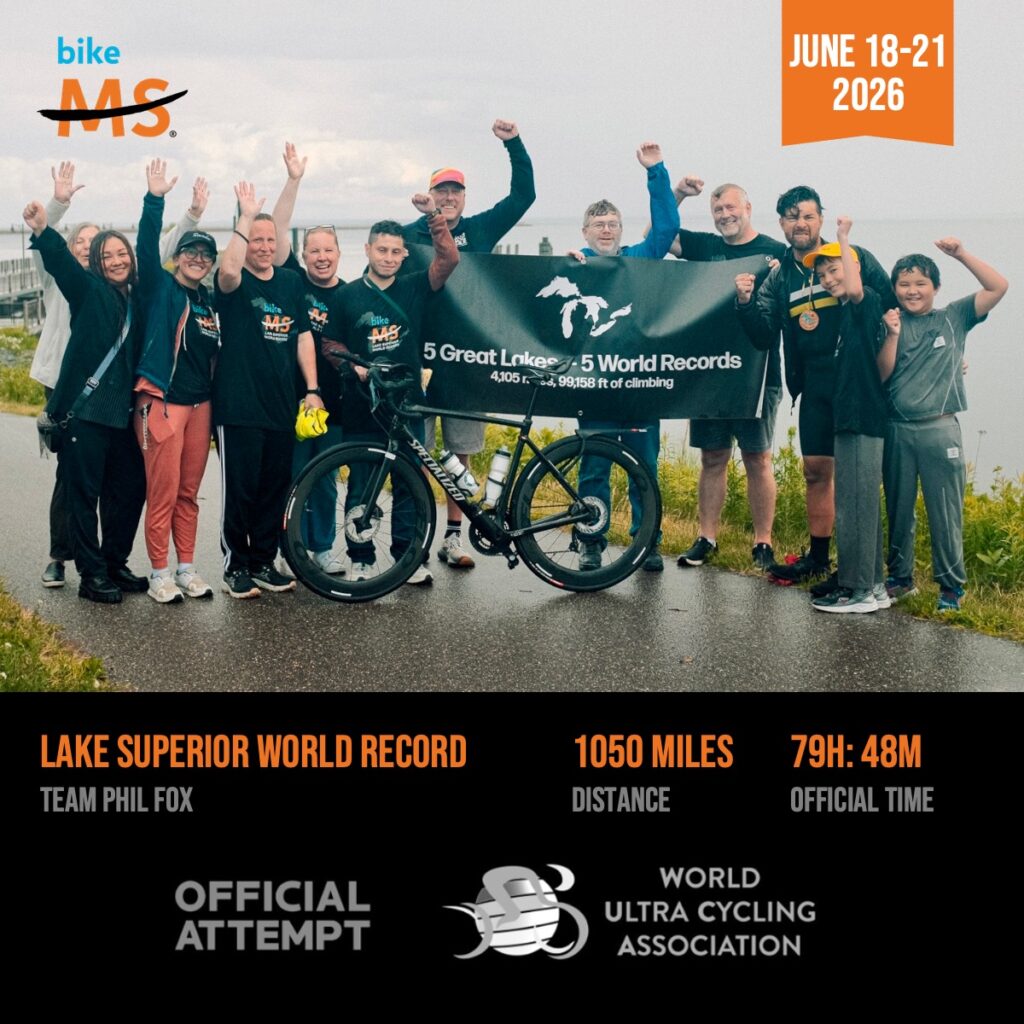
We successfully passed Marquette’s Iron Ore Dock in the rain at 1:48pm (Eastern) on Sunday, June 21, 2026.
We completed the full 1,050 mile course in an elapsed time of 79 hours, 48 minutes and were able to raise over $13,480 (and counting) in support of the National MS Society. In record time and ahead of our fundraising goal.
Acknowledgements
Thank you to 780+ donors who contributed to the cause since we started the Great Lakes project in 2021. More than $117,600 have been raised to support groundbreaking research and life-changing services for people living with MS. While we aren’t there yet, we continue to make progress towards a world free of MS.
Thank you to everyone amplifying our story including our friends at the National MS Society, the World UltraCyling Association, UltraCycling Magazine, ABC7 Chicago.
Thank you to Facteus, Infinity Bike Seats, Velofix, Specialized Chicago and Rapha Chicago.
Largely together since 2021 – this world record crew of William, Tony, Morgan, Demian, Parker Emily, and Michelle continues to keep me safe and supported. Extra credit to Kajal Joshi, first time crew member for joining in the fun and immediately fitting right in.
Together this crew has had my back through our toughest challenge yet on constantly changing conditions and little sleep with the same determination to keep moving. With each record the crew continues to find ways to make me better. These records are not accomplished in a vacuum and I cannot imagine doing it without them. I’m truly fortunate to have such an accomplished, dedicated and fun support crew.
Special thanks to Armin and Caymanite Productions for coordinating their film crew to document this last adventure. Cannot wait to see the footage captured from the crew and how the adventure unfolded.
Ultra efforts take a village and involve the countless sacrifices of my immediate family. Support on all the recon. The training. The recovery. The coordination. The distractions. Extra special acknowledgement to my parents, Suzanne, Leanne and our two boys.
Thank you to my Chicago Rando family, all my friends and colleagues. I’m truly fortunate to have the support of so many. Your enthusiasm keeps me moving.
| World Record | Distance (Miles) | Elevation (Feet) | Moving Speed (MPH) | Moving Time (H:M) | Elapsed Time (H:M) | Moving Percentage |
| Lake Michigan (2021) | 921 | 15,413 | 16.4 | 56:05 | 64:35 | 86.8% |
| Lake Erie (2023) | 626 | 7,961 | 16.1 | 39:00 | 40:36 | 96.1% |
| Lake Ontario (2024) | 512 | 13,934 | 17.3 | 29:38 | 30:36 | 96.8% |
| Lake Huron (2025) | 1,001 | 21,297 | 16.4 | 61:04 | 69:33 | 87.5% |
| Lake Superior (2026) | 1,050 | 35,584 | 15.0 | 70:12 | 79:48 | 88.0% |
| Total | 4,110 | 94,189 | 16.1 | 255:59 | 285:08 | 89.8% |
Equipment Used:
- 2019 Roubaix Pro (Aero Rig)
- Infinity Saddle E3
- Zipp Speed Weaponry Aero Bars
- FLO 64 AS Disc Wheels
- Vittoria Corsa N.Ext 32mm (TPU Tubes)
- Assioma Duo Power Pedals
- 2022 Roubaix Expert DI2 (Climbing Rig)
- Infinity Saddle E1X
- Roval CL 32 Disc Wheels
- Vittoria Corsa N.Ext 32mm (TPU Tubes)
- Assioma Duo Power Pedals
- Garmin 1040
- Lake CX242 Shoes
Nutrition Consumed:
- 40x bottles of Infinit (Custom Mix)
- 17x bottles of Ensure Plus
…and don’t judge me
- 16x Lemonhead Ropes / Rainbow Ropes
- 6x Mom’s Macadamia Cookies
- 5x Hashbrowns (McDonald’s, Tim Hortons, Other)
- 5x Tim Horton’s Pizza Squares
- 5x Breakfast Sandwiches (Tim Hortons, Circle K, Other)
- 3x Timbits Donut Holds (Tim Hortons)
- 2x McDonald’s McDoubles
- 2x McDonald’s Medium Fries
- 2x McDonald’s Apple Pies
- 2x Apple Fritters (Tim Horton’s)
- 2x Uncrustables
- 1x McDonald’s Egg McMuffin
- 1x Mountain Dew Donut (Kwik Trip)
World Record Crew
- William Edwards, Crew Chief
- Demian March, Mechanic
- Tony Moguel, Night Crew
- Brian Morgan, Night Driver
- Emily Gunnels, Night Crew / Support
- Michelle Hartman, Night Crew / Support
- Kajal Joshi, Medic / Nutrition
- Phil Parker, Night Crew
World Record Media Crew
- Amin Korsos, Director
- Csaba Korsos, Media Driver
- Chad Gilchrist, Media Crew
- Josh Fisch, Media Crew
- Henrikas Genutis, Media Crew
Additional links: